Free Mac app for sports bettors
Profit either way,
when both bets stand.
When two books disagree on a game, backing both sides at the right stakes locks in a profit, as long as both bets are accepted at the prices shown and both stand. Real gaps are rare and usually small. Switch on live Kalshi and Polymarket US prices, or type in the prices you see at your books, and Bookbreaker works out what to bet at each, rounds the stakes so they look human, and shows the profit before you bet.
Free. No account and no subscription. Needs a Mac with Apple silicon (M1 or later). 35.3 MB, notarised by Apple.
On your phone?
- Free, no subscription
- No account
- Never asks for a sportsbook login
- Your bets stay on your Mac
The app recorded on a Mac, version 0.1.27.
Knows 33 sportsbooks, exchanges and prediction markets across 51 states
Win without picking winners
Sportsbooks are built to profit whoever wins. Every so often two of them disagree enough that both sides can pay, if you get both bets on.
Betting both sides usually loses
Every book takes a cut. Bet $100 on each side of a -110 / -110 game and you lose either way.
Unless the prices disagree
Find +110 at one book and +105 at another. Bet $490 and $500, and if both bets are accepted at those prices, you win whichever side comes in.
Bookbreaker does the work
Finding those pairs by hand means watching prices all day. The app does it, then hands you the bet.
- Checks any two prices for a locked profit
- Tells you exactly what to bet at each book
- Rounds stakes so they don't look like software
- Warns you when a price is likely gone
One game. Two books. The profit if both stand.
This is what the app hands you for every gap it finds.
An example market. The stakes are rounded to amounts a book will take, which is why the two sides pay slightly differently. Prices move and books can cap or void a bet, so check both are still there before you place either.
Three steps to your first bet
- Download the appFree, 35.3 MB, for Macs with Apple silicon.
- Find a pairSwitch on Live prices to see Kalshi and Polymarket US pairs open in your state, or type the prices you see at two books. The app works out both stakes and the profit.
- Place both bets, fastBet the stakes shown at each book. If both are accepted at those prices, one side wins, one loses, and you keep the difference.
Built for the part other tools skip
Free. No subscription.
Other arbitrage tools charge every month. Bookbreaker costs nothing and needs no account.
Knows if the price is still there
A price can vanish before your bet lands. The app tells you how likely it is to still be open.
Stakes that look human
Bets to the cent are how books spot software. Bookbreaker gives you round amounts instead.
Your login stays yours
It never asks for a sportsbook password, and your betting record never leaves your Mac.
Every book’s price, and what your promo is worth
Every book’s price, side by side
The Odds screen lays out each game’s price at every sportsbook your free key reads, marks the best one, and says when it was read. Pick a bet to see its fair price and what it is worth at each book.
Which bet to place first
On an arb or a middle, the app shows what you make in each result and numbers the bets, so the price most likely to move goes in first.
Convert a promo you already have
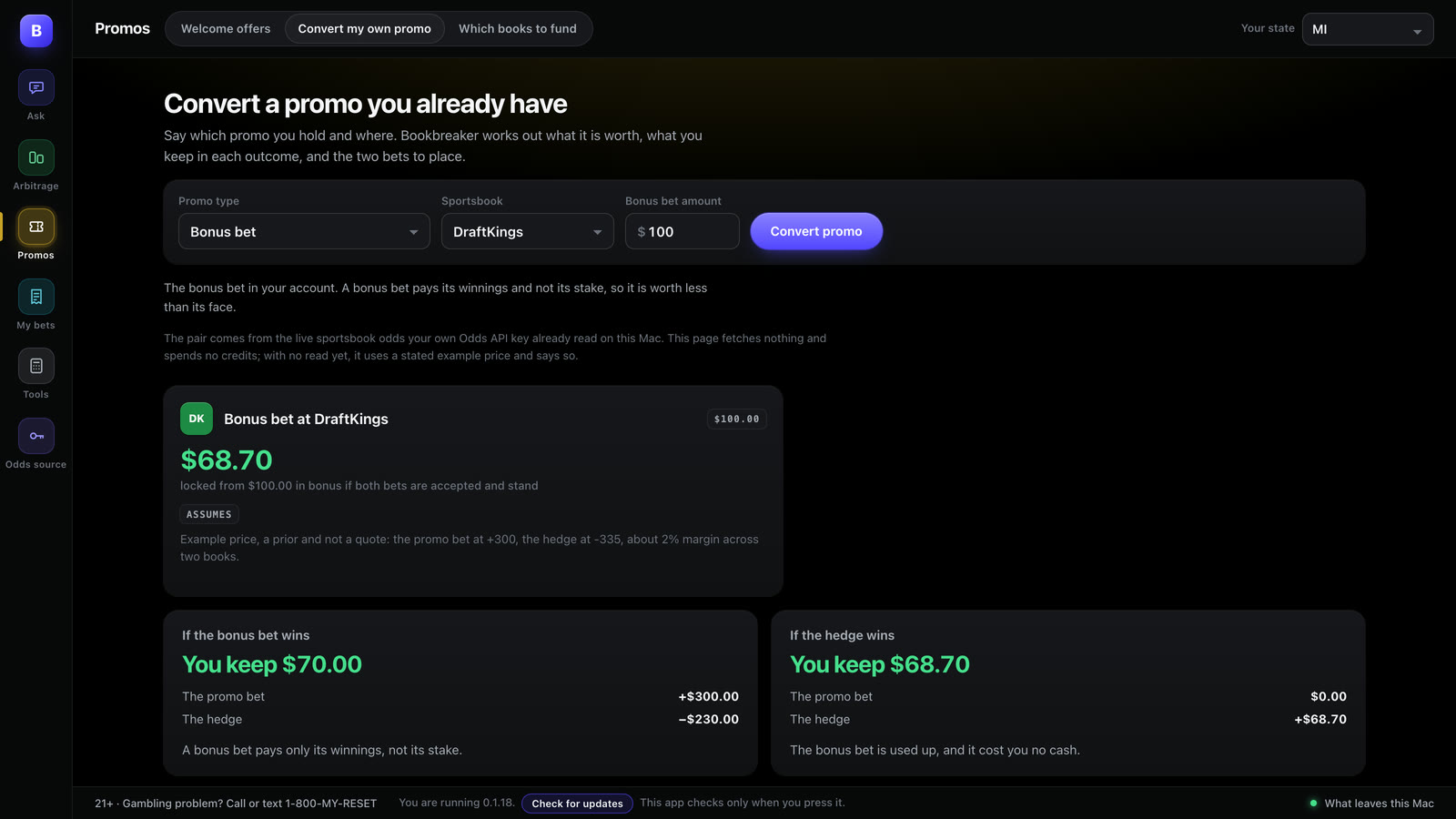
Type in a bonus bet, refund, profit boost or deposit match, the book and the amount. You see what it is worth and what you keep if each side wins.
Player props, when you want them
Off until you switch them on. Then the app tells you how many credits a refresh will cost before it reads anything.
Before you download
Is the profit locked in no matter what?
No. It is locked only if both bets are accepted at the prices shown and both stand. A price can move before your second bet lands, a book can cap your stake or void a bet, and an exchange may have only a little on offer at the price you see. Live pairs are sized to the amount on offer when the prices were read, but that can change in seconds, so check before you bet. When we priced the Kalshi and Polymarket gaps our own scanner found against what was really on offer, nearly all of them disappeared, and the one left was worth about a cent. Real gaps are rare and small. That is why the app tells you how likely each price is to still be there.
Is it really free?
Yes. There is no subscription, no account and no card. Download it and use it.
What is arbitrage betting?
Betting every side of a game at books whose prices disagree, so the winning bet pays more than the losing one costs. The full guide.
Where do the prices come from?
Switch on Live prices and the app reads Kalshi's and Polymarket US's public prices for NFL, MLB, NBA and NHL games, and shows a pair only in states where both are open. For the sportsbooks, add a free key from The Odds API (500 credits a month) and the app reads live odds from the major US books, saying what each refresh costs before it runs. Or type in the price you see and the app works out the rest.
Will betting like this get me limited?
Some books limit accounts that win. Bookbreaker rounds your stakes and shows which books in your state limit winners.
Which Macs does it run on?
Any Mac with Apple silicon (M1 or later). It is 35.3 MB and notarised by Apple.
Does it place bets for me?
No. It does the math and you place every bet yourself, at licensed books, in a state where betting is legal.
See the gaps for yourself
Free for Mac. It takes a minute to set up.
Free. No account and no subscription. Needs a Mac with Apple silicon (M1 or later). 35.3 MB, notarised by Apple.
On your phone?